Virtual reality
A headset that replaces what you see with a 3D world that follows your head.
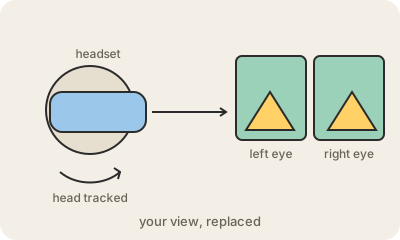
Virtual reality (VR) puts you inside a computer-generated world. You wear a headset that covers your eyes, with a small screen and lens in front of each eye. Each eye gets a slightly different image, which your brain combines into depth, and sensors track your head so that when you turn, the scene turns too. Many headsets also track your hands or handheld controllers.
The result is a sense of presence that a flat screen cannot give: you look down and see a cliff edge, you reach out and grab an object. That makes VR useful beyond games, for flight and surgery training, walking through a building before it is built, or rehearsing dangerous situations safely. Headsets like Meta Quest work on their own; others connect to a PC; Apple Vision Pro, released in 2024, mixes VR with views of the real room.
VR still has real limits. Headsets are heavy enough to tire you after a while, and when what you see moves but your body does not, some people feel motion sickness. The image must update very fast and with very little delay to feel natural, which demands serious graphics power. For now, VR is popular for gaming and fitness and growing in training, but it has not become an everyday device like the phone.
Keep in mind
- A headset shows a separate image to each eye and tracks your head.
- It replaces your view entirely, unlike augmented reality, which adds to it.
- Used for games, fitness, training and design reviews.
- Weight, motion sickness and graphics demands are its main limits.