3D printing
Making an object by stacking very thin layers of material, one on top of another.
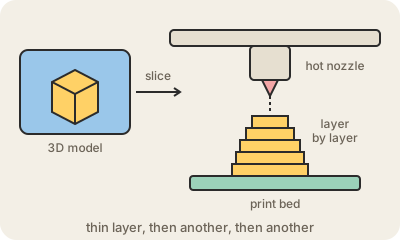
3D printing builds an object from a digital design by adding material in thin layers, each one a fraction of a millimeter thick, until the full shape appears. That is why it is also called additive manufacturing: instead of carving a block down (like a sculptor) or pouring into a mold, the printer only puts material where the object needs it.
The process starts with a 3D model, drawn in a design program or downloaded from a site that shares models. A program called a slicer cuts it into hundreds of horizontal layers and writes instructions for the printer. The most common home printers then melt a plastic thread, called filament, and trace each layer with a moving hot nozzle, like a very precise glue gun. Other types harden liquid resin with light for finer detail, or fuse metal powder with lasers for industrial parts.
Its strength is making one-off or custom pieces cheaply: a prototype before mass production, a replacement knob that is no longer sold, a hearing aid shaped to one person's ear, a dental aligner, a part for a rocket engine. Its weakness is speed. Printing a single object can take hours, so for making thousands of identical plastic pieces, a mold is still much faster and cheaper per unit.
Keep in mind
- Builds objects layer by layer from a digital 3D model.
- Home printers usually melt plastic filament; others use resin or metal powder.
- Great for prototypes, spare parts and custom pieces.
- Slow for mass production, where molds are still cheaper.