Bit and byte
The smallest unit of digital information, and the group of eight that computers count in.
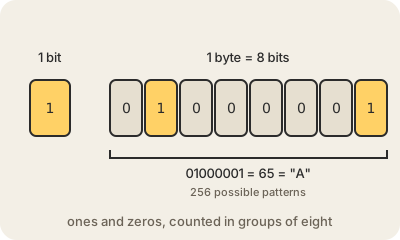
A bit is the smallest piece of information a computer handles: a single yes or no, written as 1 or 0. Inside a chip it is a tiny switch that is either on or off, or a voltage that is either high or low. One bit alone says very little, but put them together and you can represent anything: numbers, letters, colors, sound.
A byte is a group of eight bits. Eight switches can be set in 256 different ways, enough for a number from 0 to 255 or for one letter of the English alphabet. Bytes are the unit computers use to measure memory and files. A kilobyte is about a thousand bytes, a megabyte about a million, a gigabyte about a billion and a terabyte about a trillion. A short text message is a few hundred bytes; a phone photo is a few megabytes.
One detail trips people up. Storage is measured in bytes (capital B, as in GB), but internet speed is measured in bits per second (small b, as in Mbps). Since a byte is eight bits, a 100 Mbps connection downloads roughly 12 megabytes per second, not 100. Another: a computer counts in powers of two, so your operating system may show a "1 TB" drive as about 931 GB. Nothing is missing; it is the same amount counted two ways.
Keep in mind
- A bit is one 0 or 1; a byte is 8 bits, with 256 possible values.
- Files and memory are measured in bytes: KB, MB, GB, TB.
- Network speed is measured in bits per second: Mbps, Gbps.
- Divide megabits by 8 to get megabytes.