Sensor
A component that measures something in the physical world and turns it into a signal.
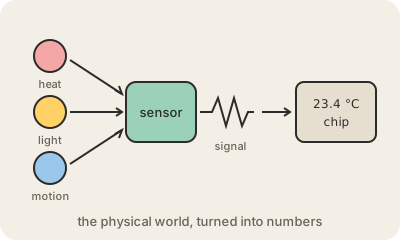
A sensor measures something physical, like temperature, light, movement, pressure, sound or humidity, and turns it into an electrical signal. A chip then converts that signal into numbers a program can use. Sensors are how electronic devices find out what is happening around them.
Your phone is full of them. The accelerometer and gyroscope notice when you rotate the screen or count your steps. A light sensor dims the display in a dark room. The proximity sensor turns the screen off when you hold the phone to your ear. The camera is an image sensor with millions of tiny light detectors, the microphone is a sound sensor, and GPS works out your position from satellite signals. A car, a smartwatch or a factory machine has many more.
Most modern sensors are tiny and cheap, often made with the same techniques as computer chips. That is what made the Internet of things possible: once measuring the world costs very little, you can put a sensor in a fridge, a field of crops or a bridge and send the readings to the cloud. A sensor is only half the story, though. Its readings drift, get noisy and need calibrating, and someone has to decide what to do with all those numbers.
Keep in mind
- Turns a physical quantity (heat, light, motion, pressure) into an electrical signal.
- A smartphone has a dozen or more: motion, light, proximity, camera, microphone.
- Small cheap sensors are what made the Internet of things possible.
- Readings need calibration and can be noisy.