Robotics
Building machines that sense the world, decide what to do, and move to do it.
Robotics is the field of designing and building robots: machines that can sense their surroundings, decide what to do and act physically, often with no person steering them step by step. It mixes mechanical engineering (arms, wheels, joints), electronics (motors, sensors, batteries) and software (the program that ties it all together).
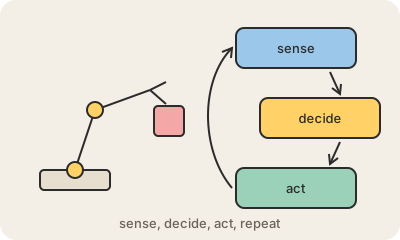
Almost every robot runs the same loop many times per second. Sense: cameras, distance sensors and touch sensors report what is around. Decide: a computer works out the next move. Act: motors turn wheels, bend joints or close a gripper. Then it senses again to see what changed. A robot vacuum bumping into a chair, backing up and turning is that loop in plain view.
Most robots today are not humanoids. They are arms welding car bodies or painting parts in factories, carts moving shelves in warehouses, machines helping surgeons make precise cuts, and vacuums in living rooms. Factory robots have long repeated the same exact motion in a fenced-off area. The newer push, helped by computer vision and machine learning, is robots that handle messy, changing places like a kitchen or a sidewalk. That is much harder than it looks: picking up an unfamiliar object is easy for a child and still tough for a machine.
Keep in mind
- Combines mechanics, electronics and software.
- Every robot runs a loop: sense, decide, act, repeat.
- Most real robots are factory arms, warehouse carts and vacuums, not humanoids.
- Handling unpredictable everyday places is still the hard part.