Autonomous vehicles
Cars and trucks that drive themselves using sensors, maps and AI.
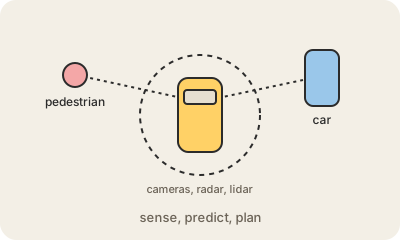
An autonomous vehicle drives without a person at the wheel, or with one who only has to step in now and then. It senses the world through cameras, radar and often lidar, a sensor that sweeps laser pulses to measure distances in 3D. Software built with machine learning turns those readings into a picture of the scene (that is a pedestrian, that car is braking), predicts what everyone will do next and plans the steering, braking and acceleration, many times per second.
Not every "self-driving" feature is the same. Engineers use the SAE scale, from level 0 to 5. Many new cars offer level 1 or 2: they keep the lane and the distance to the car ahead, but the driver must watch the road at all times and remains responsible. At level 4 the car drives itself with nobody needed at the wheel, but only inside a defined area and set of conditions. Level 5, anywhere and in any weather, does not exist yet.
Robotaxis are where level 4 is real today. Waymo carries paying passengers with nobody in the driver's seat in several US cities, and companies like Baidu do the same in China. The hard part is the long tail of rare situations: a police officer waving traffic through a red light, a mattress on the highway. How safe they are compared with human drivers, who is liable in a crash and what happens to driving jobs are all still under active debate.
Keep in mind
- Sensors (cameras, radar, lidar) plus AI that perceives, predicts and plans.
- SAE levels go from 0 (no automation) to 5 (anywhere, anytime).
- Most driver-assist systems are level 2: you are still the driver.
- Level 4 robotaxis already carry paying passengers in some cities.