Lidar
A sensor that measures distances by timing laser pulses that bounce back.
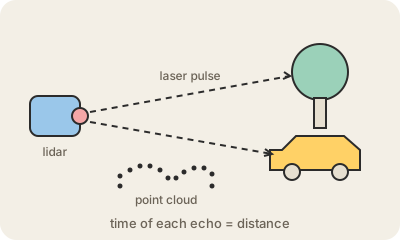
Lidar (short for light detection and ranging) measures how far away things are using light. It fires very short laser pulses, usually invisible infrared, and times how long each one takes to bounce off a surface and come back. Since light travels at a known speed, that time gives the distance. Do it many thousands of times per second while sweeping across a scene and you get a point cloud: millions of dots, each with an exact position, that together outline the shape of everything around.
It works like radar but with light instead of radio waves, which gives much finer detail. Self-driving cars and robots use lidar to see the road, pedestrians and obstacles in 3D, day or night. Planes and drones carry it to map terrain, and because some pulses slip between leaves and reach the ground, archaeologists have used it to find ancient structures hidden under forests. Since the iPhone 12 Pro, some phones and tablets include a small lidar to help with focusing in the dark and augmented reality.
Its weak spots are cost and weather. Car-grade lidar units have long been expensive, which is why some carmakers bet on cameras alone, and rain, fog or snow scatter the laser and shorten its range. Many systems combine lidar with cameras and radar so each one covers the others' gaps.
Keep in mind
- Measures distance by timing laser pulses on their round trip.
- Produces a point cloud: a 3D map made of millions of dots.
- Used in self-driving cars, robots, terrain mapping and some phones.
- Fog, rain and cost are its main limits; it is often combined with cameras and radar.