AI detector
A tool that estimates whether a text was written by AI, and is often wrong.
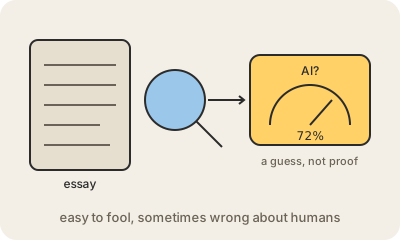
An AI detector is a program that reads a text and estimates how likely it is that a chatbot like ChatGPT wrote it. Teachers use them on essays, editors on submissions, recruiters on cover letters. Well-known ones include GPTZero and the checker built into Turnitin. They usually give a percentage or highlight suspicious sentences, not a clear yes or no.
Most look for statistical fingerprints. Language models tend to pick the most predictable next word, so their text is often smooth and even; people write with more surprises and more variety from one sentence to the next. Some detectors are themselves AI models, trained on lots of examples of human and machine text.
The trouble is that those fingerprints are weak. A light edit, a paraphrasing tool or simply asking the chatbot for a more casual style can make AI text pass as human. And human text gets flagged: a 2023 study by Stanford researchers found that popular detectors labeled a large share of essays by non-native English writers as AI-written, because simpler vocabulary looks "predictable". OpenAI withdrew its own AI text classifier that same year, citing its low accuracy. A detector score is a reason for a conversation, never proof on its own.
Keep in mind
- It gives a probability, not proof, that a text was AI-written.
- It looks for the predictable, even wording typical of language models.
- It is easy to fool with edits, and it wrongly flags some human writers.
- AI watermarks, added when the content is created, are a sturdier signal where they exist.
Go deeper
- Artificial intelligence content detection on Wikipedia
- GPT detectors are biased against non-native English writers (Stanford study, arXiv)