Drone
An aircraft with no pilot on board, flown by remote control or by its own computer.
A drone is an aircraft without a pilot inside. Someone flies it from the ground with a remote control or an app, or it follows a route on its own. The formal name is unmanned aerial vehicle, or UAV. Drones range from palm-sized toys to aircraft the size of a small plane.
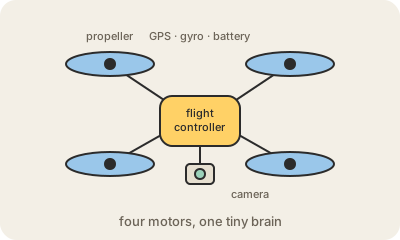
The kind most people picture is the quadcopter: four propellers on arms around a small body. It steers by changing the speed of each motor. Spin the two on one side a little faster and it tilts and moves the other way. Doing that by hand would be impossible, so a flight controller, a small computer fed by a gyroscope, an accelerometer, a barometer and GPS, makes hundreds of tiny corrections every second to keep it level and in place. Fixed-wing drones look like small planes instead and can fly much longer on a charge.
Drones are used for aerial photos and film, inspecting roofs, bridges and power lines, mapping fields and spraying crops, search and rescue, deliveries in some places, and in war. Battery life is the main limit for small ones: flights are usually measured in minutes, not hours. Because they share the sky with planes and fly over people, most countries have rules on where and how high you can fly, and some require registering the drone or getting a license.
Keep in mind
- An aircraft with no pilot on board; formally a UAV.
- Quadcopters steer by changing the speed of each of their four motors.
- A flight controller with sensors and GPS keeps it stable.
- Battery life and flight rules are the main limits.