Power supply
The box that turns wall electricity into the steady, low voltage a computer runs on.
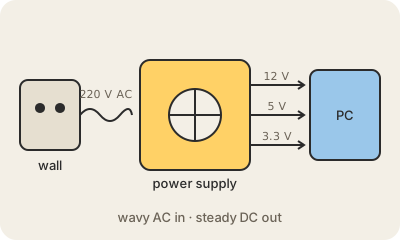
The electricity in a wall socket is alternating current (AC) at roughly 110 or 220 volts, depending on the country. Chips need something very different: direct current (DC), at low and extremely stable voltages like 12, 5 or 3.3 volts, and often even less inside the chip. The power supply does that conversion. In a desktop PC it is a metal box with a fan inside the case; in a laptop or phone it lives mostly in the charger, the power adapter you plug into the wall.
A power supply is rated in watts: how much power it can deliver at most. A basic office PC needs a few hundred watts; a gaming PC with a big graphics card can need far more. Buying one too small makes the computer shut down or restart under load. Efficiency matters too: part of the energy is lost as heat in the conversion, and better units waste less. In desktop PCs, the 80 Plus labels (Bronze, Gold, Platinum) certify that efficiency.
It is one of the least glamorous parts, and one of the most important. A cheap, poorly made power supply can give unstable voltage that causes random crashes, or fail and take other parts with it. Servers in data centers usually have two, so one can fail without the machine going down.
Keep in mind
- Converts wall AC into the low, steady DC voltages that chips use.
- Rated in watts; it has to cover the total draw with some margin.
- Efficiency labels like 80 Plus measure how little it wastes as heat.
- A bad power supply can cause random crashes or damage other parts.