Internet exchange point
A place where many internet networks plug into each other to swap traffic directly.
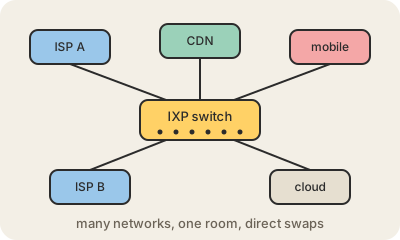
The internet is tens of thousands of separate networks: providers, mobile operators, universities, content companies, clouds. For your message to reach a site on another network, those networks have to connect somewhere. An internet exchange point, or IXP, is one of those places: usually a room in a data center with a big shared network switch, where many networks bring a cable and connect to each other at once.
What happens there is called peering: two networks agree to exchange traffic between their own users directly, usually without paying each other. The alternative is transit, paying a bigger provider to carry your traffic to the rest of the internet. Peering is cheaper and keeps local traffic local; without it, a message between two neighbors on different providers might cross an ocean and come back. Networks tell each other which addresses they can reach using BGP, often through a shared route server at the exchange.
Some of the best-known IXPs are DE-CIX in Frankfurt, AMS-IX in Amsterdam and LINX in London, and Brazil's IX.br is one of the largest systems in the world. In Argentina, CABASE runs a network of exchange points across the country. Where there is no local IXP, traffic between two local users often has to leave the country and come back, which is slower and more expensive, so building one is a common step to improve a country's internet.
Keep in mind
- An IXP is a physical place where many networks interconnect.
- Networks peer there, swapping traffic directly and usually for free.
- It cuts costs and latency by keeping local traffic local.
- DE-CIX, AMS-IX, LINX and IX.br are among the biggest.