Internet backbone
The highest-capacity long-distance links that carry traffic between big networks.
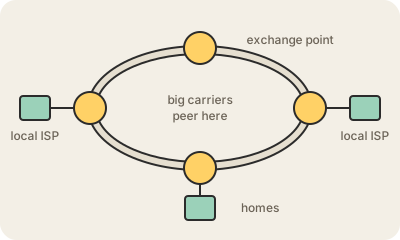
The internet is a network of networks, and they are not all the same size. Your home connects to your local provider, which connects to bigger regional networks, which connect to a small group of very large carriers running fiber across countries and under oceans. Those core long-distance, high-capacity links are called the internet backbone.
There is no single owner. The backbone is many companies' networks stitched together. They meet at internet exchange points and in shared data centers, where they swap traffic. The biggest carriers, called Tier 1 networks, can reach every part of the internet just by exchanging traffic with each other for free, known as peering, without paying anyone for transit. Smaller providers pay them to carry their traffic further.
Most of the time you never think about it, but it shapes your experience. Submarine cables are part of the backbone, so when one is cut, whole regions can slow down. Its capacity grows every year to keep up with video and cloud traffic, and because routes are redundant, traffic usually finds another way around a failure, sometimes with extra latency.
Keep in mind
- The core long-distance links that carry traffic between big networks.
- Owned by many companies, not one; they meet at exchange points.
- Tier 1 networks reach the whole internet by peering, without paying for transit.
- Submarine cables are part of it; redundancy routes around most failures.