Egress fees
What a cloud provider charges you for data leaving its network.
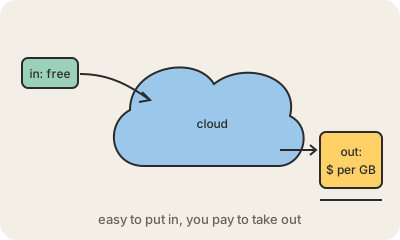
Egress fees are the charges for data that goes out of a cloud provider's network: to users on the internet, to another cloud, or back to your own office. Data coming in, called ingress, is usually free. So uploading a terabyte of videos to cloud storage costs nothing to transfer, but serving those videos to viewers is billed for every gigabyte that leaves.
On AWS, data sent out to the internet is priced per gigabyte, with lower rates at higher volumes, and AWS gives 100 GB a month free across its services. Traffic between regions, and in many cases between availability zones in the same region, has its own prices too. For a video platform, a download site or an API that returns large files, egress can end up bigger than the bill for the servers themselves.
Egress fees matter beyond the invoice because they make leaving expensive: moving years of data to another provider can cost a lot just in transfer. Critics see them as a source of vendor lock-in, and regulators have noticed; the EU Data Act requires providers to phase out switching charges. AWS, Google Cloud and Microsoft Azure have all announced free egress for customers who move all their data out. Common ways to cut egress are a CDN, compression, and keeping chatty services in the same region.
Keep in mind
- Charged per gigabyte for data leaving the cloud; incoming data is usually free.
- Traffic between regions or zones often has its own price.
- Can exceed compute costs for apps that serve a lot of data.
- Makes switching providers costly, so regulators are pushing back.
Go deeper
- Data transfer pricing, in Amazon EC2 On-Demand pricing
- Free data transfer out when moving out of AWS (AWS blog)
- The EU Data Act (European Commission)