Cooling and heat sinks
How computers get rid of the heat their chips produce so they do not slow down or fail.
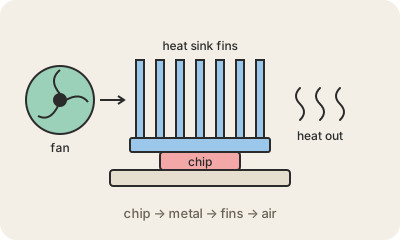
Every chip turns almost all the electricity it uses into heat. A laptop processor can produce as much heat as a small light bulb, packed into a square the size of a fingernail. If that heat stays there, the chip gets too hot, so every computer needs a way to move it out: that is cooling.
The most common part is the heat sink: a block of metal, usually aluminum or copper, pressed against the chip and shaped into thin fins. The fins give the heat a big surface to escape into the air, and a fan blows fresh air through them. A thin layer of thermal paste fills the tiny gaps between chip and metal. Gaming PCs and servers sometimes use liquid cooling, which carries the heat away in a tube of fluid to a radiator. Phones and fanless laptops just spread it through the case.
When cooling cannot keep up, the chip protects itself by slowing down, which is called thermal throttling. That is why a laptop on a blanket feels sluggish, or a phone in the sun gets slow while recording video. Data centers face the same problem at a huge scale, and a big share of their electricity goes just to cooling.
Keep in mind
- Chips turn nearly all their power into heat.
- A heat sink spreads that heat over metal fins; a fan moves it into the air.
- Too hot and the chip slows itself down (thermal throttling).
- Blocked vents and dust are the most common cause of a hot, slow computer.