Zigbee and Matter
Two standards that let smart home devices from different brands talk to each other.
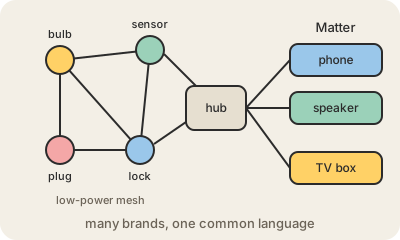
Smart bulbs, door sensors, plugs and locks need a way to talk to each other and to your phone. Wi-Fi drains small batteries, so the industry built lighter options. Zigbee, around since the mid-2000s, is a low-power radio protocol made for exactly this: tiny devices that can run for months or years on a coin battery. Zigbee devices form a mesh, where plugged-in devices relay messages for the others, and they reach your home network through a hub or bridge, like the one sold with Philips Hue bulbs.
The problem was fragmentation: a device built for one brand's hub often would not work with another's. Matter, launched in 2022, is the fix the big players agreed on. Apple, Google, Amazon and Samsung all support it, along with many device makers, and it is run by the Connectivity Standards Alliance, the same group that created Zigbee. A Matter device works with Apple Home, Google Home, Alexa and SmartThings, and it is controlled locally, inside your home, so basic control does not depend on a company's cloud.
Matter is a common language, not a radio. It runs over Wi-Fi, Ethernet and Thread, a low-power mesh radio similar to Zigbee. Thread needs a border router to reach your home network, a job many recent smart speakers and TV boxes already do. Zigbee devices are not Matter devices, but some hubs bridge them in, so older gear is not necessarily wasted.
Keep in mind
- Zigbee is a low-power mesh radio for small smart home devices.
- Matter, launched in 2022, makes devices work with Apple, Google, Amazon and Samsung alike.
- Matter runs over Wi-Fi, Ethernet and Thread, and works locally.
- Both come from the Connectivity Standards Alliance, once called the Zigbee Alliance.
Go deeper
- Matter (Connectivity Standards Alliance)
- Zigbee (Connectivity Standards Alliance)
- Matter on Wikipedia