Voice assistant
Software you talk to out loud that answers back and does small tasks for you.
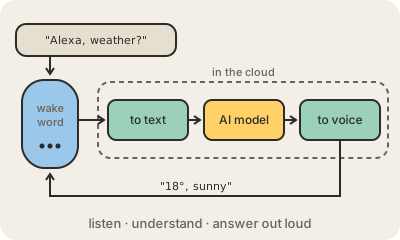
A voice assistant is a program you control by speaking: Siri on the iPhone, Alexa on Amazon's Echo speakers, Google's assistant on Android phones and Nest speakers. You say a wake word ("Hey Siri", "Alexa"), ask something, and it answers out loud or does it: set a timer, play a song, turn off the lights, read a message.
Behind the scenes there is a chain of steps. The device listens locally for the wake word only. Once it hears it, it records your request and, usually, sends the audio to the company's servers. There, speech recognition turns sound into text, a model works out what you want, and the reply is turned back into speech. All of that has to happen in a second or two to feel natural.
The classic assistants were good at a fixed list of commands and bad at real conversation. That is changing as companies rebuild them on large language models, so they can follow up on what you said before and handle looser requests. The trade-offs remain: a microphone in your home, recordings stored in the cloud, and occasional mishearings that trigger it when nobody called it.
Keep in mind
- Siri, Alexa and Google's assistant are the best-known examples.
- Only the wake word is detected on the device; the rest usually goes to the cloud.
- Speech becomes text, a model works out the answer, and the answer becomes speech.
- Newer versions use language models to hold a more natural conversation.