Vibe coding
Building software by describing what you want to an AI and accepting its code.
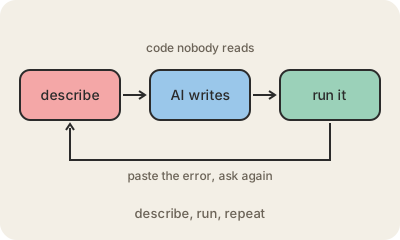
Vibe coding means making a program mostly by talking to an AI: you describe what you want in plain words, the AI writes the code, you run it, and if something breaks you paste the error back and ask for a fix. You barely read the code, if at all. AI researcher Andrej Karpathy coined the term in February 2025, and it caught on fast.
Coding assistants and app builders like Cursor, Claude Code, Lovable, Replit or Bolt make this possible even for people who have never programmed. A teacher can build a quiz app in an afternoon; a founder can show investors a working prototype instead of slides. For programmers, it is a quick way to try an idea or write a throwaway script.
The catch is that code nobody reads is code nobody understands. It can work in the demo and still hide security holes, leak an API key, or fall apart when real users arrive. The common view is that vibe coding is great for prototypes and personal tools, and that anything handling other people's data or money needs someone who reads, tests and understands the code. Using AI to write code that you then review carefully is AI-assisted programming, not vibe coding.
Keep in mind
- You describe, the AI writes, you test by running it.
- Andrej Karpathy coined the term in early 2025.
- Great for prototypes and personal tools.
- Code nobody reviews can hide bugs and security holes.