Text-to-image
AI that draws a brand-new picture from a written description.
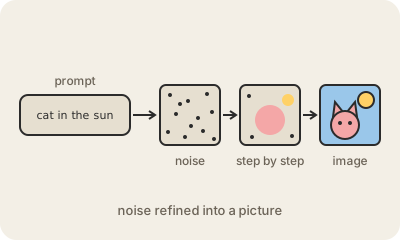
A text-to-image model creates a picture from a sentence. You type "a capybara reading the newspaper in a Buenos Aires café, watercolor" and seconds later you get an image that never existed before. DALL·E, Midjourney, Stable Diffusion, Google's Imagen and the image features built into chatbots like ChatGPT and Gemini all do this.
These models learn from huge collections of images paired with captions. Most of them are a diffusion model: the system starts from pure random noise and removes it step by step, guided at each step by the meaning of your text, until a coherent picture appears. Some newer systems generate images inside a multimodal model, with an approach closer to how an LLM writes text.
They are handy for sketches, illustrations, mockups and ads, and they raise real questions. Many artists object that their work was used for training without permission, and there are lawsuits over copyright. Realistic fake photos, or deepfakes, can spread misinformation or be used to harass people, so many tools add a watermark or metadata marking the image as AI-made, and laws like the EU AI Act require that kind of labeling. They also still trip on some details, like exact lettering on a sign, though each generation gets better at it.
Keep in mind
- You write a description (a prompt) and get a new image.
- Most use diffusion: noise refined step by step into a picture.
- Trained on huge sets of captioned images, which fuels copyright debates.
- Many tools mark their output as AI-generated.