Refresh rate
How many times per second a screen redraws its picture, measured in hertz (Hz).
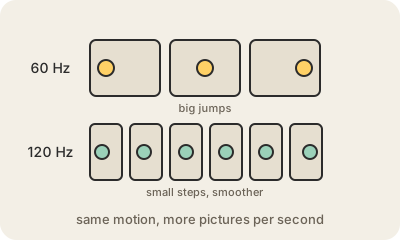
A screen does not show continuous motion. It shows still images one after another, fast enough that your eyes blend them into movement. The refresh rate is how many times per second the screen redraws itself. A 60 Hz screen redraws 60 times a second; a 120 Hz screen, 120 times.
For decades 60 Hz was the norm. Today many phones, tablets and laptops run at 90 or 120 Hz, and gaming monitors go to 144 Hz, 240 Hz or more. The difference is easiest to notice when things move: scrolling a long page, dragging a window, or turning the camera in a game feels smoother and more direct, because each picture is closer to the last one.
A higher refresh rate costs battery, so many phones use a variable refresh rate: they drop to a low rate when you are reading something still, and speed up when you scroll. The screen is only half the story, though. If the device cannot produce new images that fast, a 120 Hz screen just repeats the same picture. Refresh rate is different from resolution: one is how many times per second, the other is how many pixels.
Keep in mind
- Measured in hertz: 60 Hz means 60 new pictures per second.
- Higher rates make scrolling and motion look smoother.
- Variable refresh rate saves battery by slowing down when nothing moves.
- Not the same as resolution, which counts pixels, not redraws.