Network gateway
The device where one network ends and traffic is handed to another.
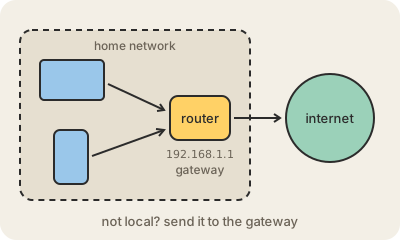
A network gateway is the point where traffic leaves one network and enters another. Every device on a network knows its neighbors, but for anything outside it needs a door. That door is the gateway: usually a router that is connected to both sides and knows how to pass packets across.
At home you meet it as the default gateway. Your laptop looks at each destination IP address: if it is on the local network, it talks to that device directly; if not, it sends the packet to the default gateway, typically your router at an address like 192.168.1.1, and lets it handle the rest. You can see yours in your network settings, or with ipconfig on Windows and ip route on Linux. If the gateway is wrong or down, you can still reach the printer next to you but not the internet.
The word is used more broadly too. A gateway can translate between networks that speak different protocols, like the box that connects a building's old phone system to internet calls, or the device that links smart-home gadgets on Zigbee to Wi-Fi. In the cloud, services named "gateway" play the same role: they are the controlled entry or exit between a private network and the outside.
Keep in mind
- The exit point from one network into another, usually a router.
- Devices send anything not on the local network to the default gateway.
- At home it is your router, often at an address like 192.168.1.1.
- Broken gateway: local devices still work, the internet does not.