Model card
The fact sheet published with an AI model: what it's for, how it was tested, its limits.
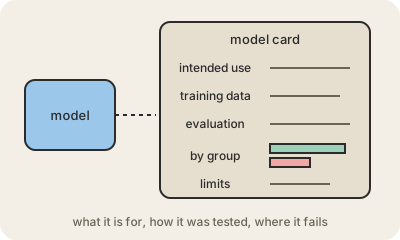
A model card is a short document that comes with a machine learning model and explains it to the people who might use it. It says what the model is for, what data it was trained on, how it was evaluated, where it performs badly and what it should not be used for. Think of it as the label and the leaflet of the model.
The idea comes from a 2018 paper by Margaret Mitchell and colleagues at Google, "Model Cards for Model Reporting". They pointed out that models were being released with no information about, for example, whether a face analysis system worked equally well for different groups of people. A model card should report results broken down by group, so those gaps become visible.
Today it is standard practice. Every model on Hugging Face has a model card as its main page, written in Markdown with a block of metadata such as the license and languages. Big AI labs publish longer versions, often called system cards, with each major model: AI benchmark results, safety tests, known risks and what was done about them. Anthropic, OpenAI and Google DeepMind all publish them.
A model card is written by whoever made the model, so it shows what they chose to measure and disclose. It is a starting point for judging a model, not an independent audit. Some rules, such as the EU AI Act, now require similar technical documentation for general-purpose AI models.
Keep in mind
- It describes purpose, training data, evaluation, limits and uses to avoid.
- Proposed by Google researchers in 2018; now standard on Hugging Face.
- Big labs publish longer system cards with each major model.
- Written by the maker, so it informs but does not replace independent testing.
Go deeper
- Model Cards for Model Reporting (original paper, arXiv)
- Model cards (Hugging Face docs)
- Model system cards (Anthropic)