Submarine cables
Cables on the ocean floor that carry almost all the internet traffic between continents.
When you watch a video hosted in another continent, the data almost certainly crossed the ocean through a submarine cable, not a satellite. There are several hundred of these cables lying on the seabed, together more than a million kilometers long, and they carry the vast majority of traffic between continents: video calls, bank transfers, cloud backups, everything.
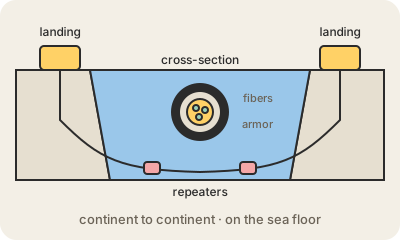
Inside, they are surprisingly thin. The heart is a handful of fiber optic strands, each thinner than a hair, carrying light. Around them go layers of copper, plastic and, near the coast where anchors and fishing nets are a danger, steel armor; in the deep ocean the whole cable is roughly the width of a garden hose. Every 50 to 100 kilometers a repeater boosts the light signal, powered by electricity sent down the cable itself from the shore. Each end arrives at a landing station on the coast that connects it to land networks.
Cables used to be built by groups of phone companies; today Google, Meta, Amazon and Microsoft own or co-own many new ones. They break more often than you would think, mostly from ship anchors and fishing, and repair ships have to hook the cable up from the seabed. Because there are many routes, traffic usually just goes around a break, but countries served by one or two cables, especially islands, can lose most of their connection for days.
Keep in mind
- Carry the vast majority of internet traffic between continents.
- Fiber optic strands inside, armored near the coast, hose-thin in deep water.
- Repeaters along the route boost the signal; landing stations connect them to land.
- Big tech companies now own or co-own many of the newest cables.