Forecasting
Using past data to estimate future numbers, with an honest range around the guess.
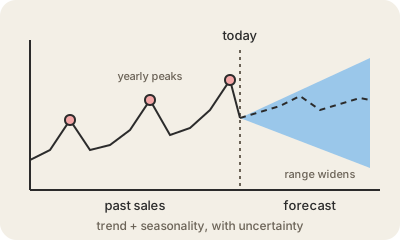
Forecasting is estimating future values from past data: how many umbrellas a store will sell next month, how much electricity a city will use tomorrow at 7 PM, how many calls a support center will get on Monday. Most forecasts start from a time series, a sequence of measurements over time.
A forecasting model looks for patterns it expects to continue. Trend is the long-run direction, up or down. Seasonality is the repeating rhythm, like higher sales every December or lower traffic every Sunday. Classic methods such as moving averages, exponential smoothing and ARIMA capture these; machine learning models can add outside signals like weather, prices or holidays.
A good forecast is not one number but a range: "between 900 and 1,100 units, most likely around 1,000". The further ahead you look, the wider that range gets. Teams check models by backtesting: pretending it is last year, forecasting, and comparing with what actually happened. Forecasts drive real decisions, such as how much stock to order or how many people to schedule, so being clear about the uncertainty matters as much as the number itself.
Keep in mind
- Estimates future values from historical data, usually a time series.
- Looks for trend and seasonality; can add outside factors like weather or holidays.
- A useful forecast comes with a range, which widens the further ahead it goes.
- Backtesting against past periods shows how much to trust a model.