Data mart
A small, focused slice of the company's data, shaped for one team.
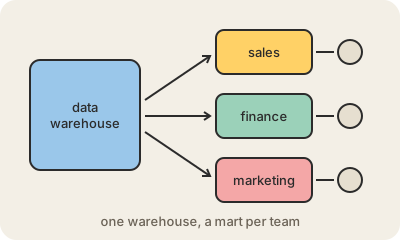
A data mart is a set of tables built for one part of a business, like sales, finance or marketing. It holds only the data that team needs, already cleaned, joined and named in the words they use. Where a data warehouse tries to cover the whole company, a data mart covers one subject.
Most data marts are carved out of a warehouse. The data team takes the raw orders, customers and payments, and builds a sales mart with a table of orders per day, per store and per product, ready to plug into a dashboard. Finance gets its own mart with invoices and margins. Today this is often just a separate schema inside the same warehouse, built with tools like dbt, rather than a separate machine.
Marts make life easier for analysts: fewer tables, clearer names, faster queries. The risk is the opposite of their strength. If every team builds its own mart with its own definition of "revenue", the numbers stop matching across meetings. That is why marts work best when they all come from the same warehouse and share definitions.
Keep in mind
- A subset of data organized for one team or subject.
- Usually built from a data warehouse, often as its own schema.
- Simpler and faster to query than the whole warehouse.
- Marts with different definitions of the same metric cause mismatched numbers.