Tor
A volunteer network that hides who you are by bouncing traffic through three relays.
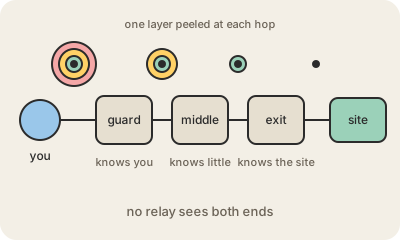
Tor (originally "The Onion Router") is a free network that makes it hard to tell who is visiting which website. Instead of going straight from your computer to the site, your traffic hops through three relays, servers run by volunteers around the world. Roughly seven thousand relays are online at any time, and the software is maintained by the nonprofit Tor Project. Most people use it through the Tor Browser, a modified Firefox.
The trick is onion routing. Before sending, your browser wraps the message in three layers of encryption, one for each relay. The first relay (the guard) removes its layer and only learns that the data came from you and goes to the middle relay. The middle relay only knows the guard and the exit. The exit relay removes the last layer and sends the request to the website, which sees the exit's IP address, not yours. No single relay knows both who you are and what you are visiting.
Journalists, activists in censored countries, abuse survivors and ordinary people who value privacy use Tor; so do criminals, which is why it is often associated with the dark web, where sites with .onion addresses are reachable only through Tor. It is slower than a normal connection because of the extra hops. And it has limits: the exit relay can read traffic that is not protected by HTTPS, and logging into your personal accounts, or downloading files and opening them outside the browser, can reveal who you are anyway.
Keep in mind
- Traffic passes through three volunteer relays: guard, middle and exit.
- Layered encryption means no relay knows both the sender and the destination.
- Websites see the exit relay's IP address, not yours.
- Slower than normal browsing, and HTTPS is still needed past the exit relay.