Supercomputer
Thousands of computers wired together to work on one huge calculation at once.
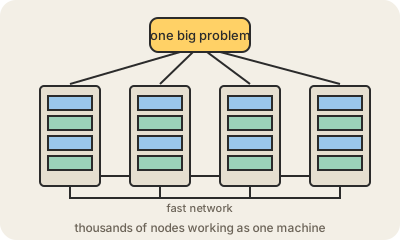
A supercomputer is not one giant processor. It is thousands of ordinary-looking servers, called nodes, packed into rows of racks and connected by an extremely fast network so they can behave like a single machine. Each node has its own CPUs, and today most of the computing power comes from GPUs. The total can reach more than a quintillion calculations per second, the level known as exascale.
The trick is splitting one big problem into many small pieces that run at the same time, then combining the results. That works well for simulations: weather and climate forecasts, how a new drug molecule folds, how air flows over a wing, how a nuclear weapon ages without testing it. This field is called high-performance computing, or HPC. The fast network matters as much as the chips, because the pieces constantly need to exchange data with their neighbors.
Twice a year, the TOP500 list ranks the fastest public supercomputers in the world; the top spots usually belong to national laboratories in the United States, Europe, Japan and China. The line with AI has blurred: the clusters that big companies build to train large language models use the same ingredients (thousands of GPUs, fast networks, heavy cooling) and are, in practice, supercomputers. They also consume a lot of power, often tens of megawatts, roughly what a small town uses.
Keep in mind
- Thousands of nodes with CPUs and GPUs, connected by a very fast network.
- Splits one big problem into pieces that run in parallel.
- Used for climate, physics, medicine and engineering simulations, and now AI training.
- The TOP500 list ranks the fastest ones twice a year.