Peer-to-peer
A network where computers talk directly to each other, with no central server in charge.
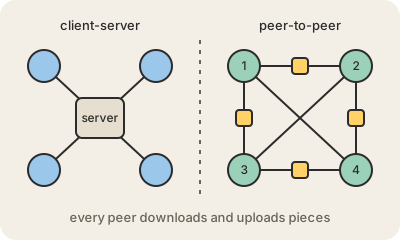
Most of the internet is client-server: your phone asks a company's server, and the server answers. In a peer-to-peer (P2P) network every participant, or peer, is both client and server at once. Each one downloads from others and uploads to others, so there is no single machine that everything depends on.
The best-known example is BitTorrent. A large file is split into small pieces, and each peer downloads different pieces from many peers at the same time while sharing the pieces it already has. The more people want a file, the more sources it has, which is the opposite of what happens to a server under load. Linux distributions and game updates use it to save bandwidth. The same idea is behind blockchains like Bitcoin, where every node keeps a copy of the ledger, and behind many video calls, which send audio and video straight between participants when NAT and firewalls allow it.
The trade-offs: there is nobody in charge to stop bad content or bad actors, peers come and go so availability is unpredictable, and anyone you connect to can see your IP address. P2P is a way to build networks, neither legal nor illegal in itself; what is shared over it is what matters.
Keep in mind
- In P2P every peer both consumes and provides resources.
- BitTorrent splits files into pieces downloaded from many peers at once.
- More users means more capacity, not more load on one server.
- Peers can see each other's IP addresses.