AWS Global Accelerator
Fixed IP addresses that pull users onto AWS's own network near them and route to a healthy region.
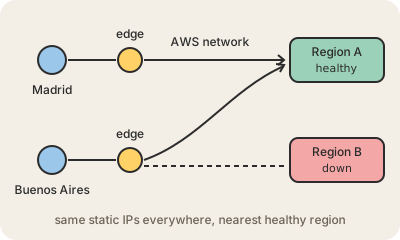
AWS Global Accelerator gives your application a small set of static IP addresses, two IPv4 addresses by default, that are announced with anycast from AWS edge locations around the world. A user in Madrid and a user in Buenos Aires connect to the same IPs, but each one enters AWS at a nearby edge. From there, the traffic rides AWS's private global network to your servers instead of crossing many hops of the public internet, which usually means less jitter and fewer lost packets.
Behind the IPs you put endpoints: Application or Network Load Balancers, EC2 instances or Elastic IPs, in one or several regions. In a standard accelerator, Global Accelerator checks their health and sends each user to the closest healthy region, and a traffic dial lets you turn down the share of traffic a region receives. If a region fails, traffic moves to the next healthy region and clients keep using the same IPs, with no DNS change to wait for. A custom routing accelerator instead maps users to a specific instance and port, which multiplayer game servers use to put players in the same session.
It works at the TCP and UDP layer and does not cache anything, which is the key difference from Amazon CloudFront. CloudFront is for HTTP content that can be cached near users; Global Accelerator is for any TCP or UDP traffic, like games, VoIP or APIs, that needs stable IPs and fast regional failover.
Keep in mind
- Provides static anycast IPs, two IPv4 by default, that stay with the accelerator while it exists.
- Traffic enters AWS at the nearest edge and travels on the AWS global network.
- Health checks move users to another region without DNS changes.
- Works for TCP and UDP and does not cache; CloudFront is the HTTP caching option.