Snowflake
A data warehouse sold as a cloud service, billed by how much computing you use.
Snowflake is an American company founded in 2012 by Benoit Dageville, Thierry Cruanes and Marcin Żukowski, database engineers who had worked at Oracle and on the Vectorwise engine. Its product is a data warehouse delivered entirely as a cloud service: you load your company's data, query it with SQL, and never install or tune a server. It runs on AWS, Microsoft Azure and Google Cloud, and went public in 2020 on the New York Stock Exchange.
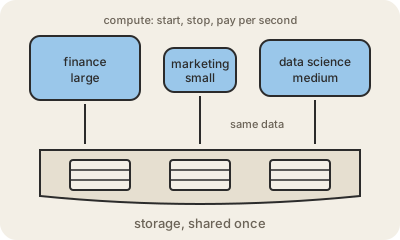
Its key design choice was to separate storage from compute. All data lives once in cheap cloud storage, and you start independent groups of servers, which Snowflake calls virtual warehouses, to query it. Finance can run a big month-end report on a large warehouse while marketing runs small queries on another, without slowing each other down, and each one can be paused when idle. You pay for storage plus the seconds of compute you actually use.
That model made it easy to share data, too: one company can give another live access to a table without sending copies. Its main rival is Databricks, which came from the data lake side; both now offer warehouses, data lake features and tools for building AI on company data, and many large companies use both.
Keep in mind
- A cloud data warehouse queried with SQL, with no servers to manage.
- Storage and compute are separate; each team can get its own warehouse.
- Usage-based pricing: storage plus compute time actually used.
- Runs on AWS, Azure and Google Cloud; competes mainly with Databricks.