Open data
Data anyone can freely download, use and share, for any purpose.
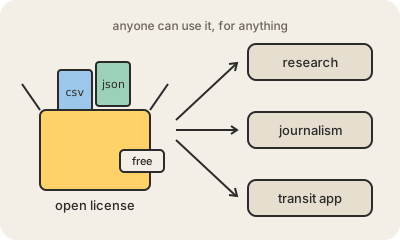
Open data is data published so that anyone can access it, use it, change it and share it, for free and for any purpose, usually only asking that you credit the source. Common examples are government budgets, public transport schedules, weather records, election results, census figures and scientific measurements.
To be truly open, data needs more than being visible on a website. It should come under an open license that allows reuse, and in a format machines can read, like CSV or JSON, rather than a scanned PDF. Many countries run open data portals for this, such as data.gov in the United States, data.europa.eu in the European Union or datos.gob.ar in Argentina.
Open data matters because it lets people outside the institution that collected it find value in it. Transit apps use open bus timetables, journalists cross public contracts with company registries, and researchers and AI models are trained on open datasets. It also supports transparency: citizens can check what governments spend. Personal data is the big exception and has to be anonymized or kept out.
Keep in mind
- Free to access, use, modify and share, for any purpose.
- Needs an open license and a machine-readable format like CSV.
- Governments publish it in open data portals.
- Personal data must be anonymized or excluded.