Cloud migration
Moving a company's apps and data from its own servers to a cloud provider.
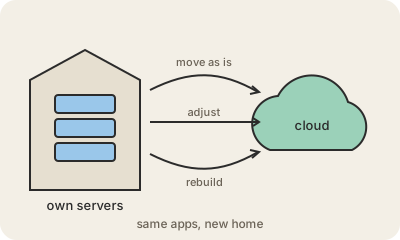
A cloud migration is the project of moving software, data and workloads from servers a company owns, often in its own building or a rented data center, to a cloud provider like AWS, Google Cloud or Azure. It can also mean moving from one cloud to another.
There are a few common strategies. Lift and shift moves an app as it is onto cloud virtual machines: fastest, but you keep the old design and its costs. A middle path adjusts a few pieces, for example swapping a self-run database for a managed one. The deepest option rebuilds the app to use cloud services fully, which takes longer but gets more of the benefits. Some old systems are simply retired or replaced by a SaaS product instead.
Companies migrate to stop buying and maintaining hardware, to scale more easily and to reach new services. It is rarely a single weekend: big organizations move in waves over months or years, start with an inventory of what they run, and test each step. The costs also change shape, from buying machines every few years to a monthly bill that needs watching.
Keep in mind
- Moves apps and data from own servers to a cloud provider, or between clouds.
- Lift and shift is fast; rebuilding for the cloud is slower but gets more out of it.
- Large migrations happen in waves, after an inventory of what exists.
- Spending turns from buying hardware into a monthly bill to manage.