AWS Systems Manager
A toolbox for running, patching and logging into a whole fleet of servers at once.
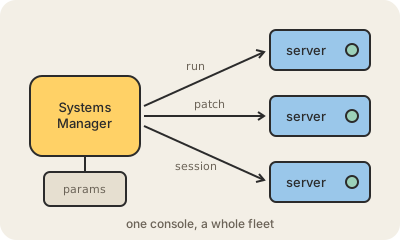
AWS Systems Manager is a set of tools for operating many servers without visiting each one. It works with EC2 instances and also with machines in your own office or data center. On each server runs a small program, the SSM Agent, that checks in with AWS and carries out instructions; an IAM role decides what it is allowed to do.
The parts people use most: Session Manager opens a terminal on a server from the browser or the command line, with no SSH keys and no open ports, and can log every command typed. Run Command executes the same script on a hundred machines at once. Patch Manager installs operating system updates on a schedule. Parameter Store keeps configuration values, like a database address or a feature flag, and can store them encrypted with KMS.
It matters because servers that are patched by hand, with SSH keys passed around a team, tend to drift and leak. Systems Manager turns those chores into something repeatable and recorded. For secrets that need automatic rotation, teams often use AWS Secrets Manager instead of Parameter Store; for everyday config, Parameter Store is simpler and its standard tier is free.
Keep in mind
- Manages EC2 and on-premises servers through the SSM Agent.
- Session Manager gives shell access without SSH keys or open ports.
- Run Command and Patch Manager act on whole fleets at once.
- Parameter Store holds configuration values, optionally encrypted.
Go deeper
- What is AWS Systems Manager? (official docs)
- AWS Systems Manager Session Manager (official docs)
- AWS Systems Manager Parameter Store (official docs)